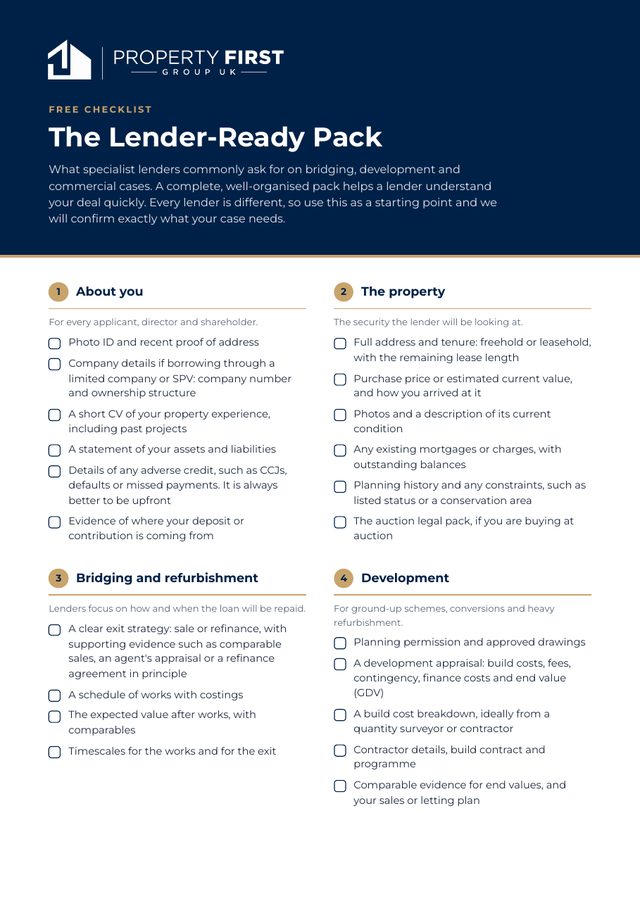
Where development finance fits
Ground-up development
For new-build schemes where funding is needed for land, construction costs and staged drawdowns as the project progresses.
Conversions
For changing the use or layout of a property, such as commercial-to-residential or larger residential reconfiguration projects.
Heavy refurbishment
For projects that need meaningful works before the property can be sold, let or refinanced onto a longer-term facility.
Land and planning-led projects
For opportunities where the planning status, site value and proposed exit need to be clearly understood by funders.
How we can help
Property First Group UK helps developers and investors shape their enquiry before it reaches a lender. We can help review the deal structure, required loan amount, borrower contribution, build costs, contingency, gross development value, professional team and exit route.
We also help identify suitable lender appetite, whether the project needs senior development finance, bridging finance, private lending, equity support or a more bespoke funding route. The aim is to present the project in a way that is clear, realistic and aligned with what funders need to see.
How development finance works
- Appraisal: we review your land or property cost, build costs, contingency, fees, gross development value and timescale.
- Structuring: we work out the funding required for the purchase and the build, and what you will contribute.
- Lender terms: we present the scheme to suitable development lenders and compare the terms available.
- Due diligence: the lender values the site and the finished scheme and reviews your planning, team and build programme.
- Drawdowns: funds are released in stages as the lender's monitoring surveyor signs off the work.
- Exit: the loan is repaid from unit sales or a refinance once the scheme is complete.
Costs to budget for
Development finance usually involves interest (often rolled up and paid at the end), an arrangement fee, valuation and monitoring surveyor fees, legal fees and, with some lenders, an exit fee. The structure and costs vary considerably between lenders, so we compare the options and set out the full costs before you commit.
Frequently asked questions
What is property development finance?
Development finance is short-term funding for building new property or carrying out major conversions and refurbishments. It usually covers part of the land or property purchase and the build costs, released in stages as the work progresses.
How are development finance funds released?
Build funds are normally released in stages, known as drawdowns, after a monitoring surveyor appointed by the lender confirms that each stage of work has been completed.
Can first-time developers get development finance?
It can be possible, particularly on smaller schemes with an experienced contractor and professional team, a robust appraisal and a sensible contribution. Each lender sets its own experience requirements.
Do I need planning permission?
Most development lenders require full planning permission, or a clear route to it, before they will fund the build. Some will consider funding a site purchase while planning is obtained, usually as a separate bridging loan.
How is development finance repaid?
Usually by selling the completed units or by refinancing onto longer-term finance. Where units are not sold by the end of the build loan, development exit finance can provide more time.
Have a development project to fund?
If you are looking at land, a conversion, a refurbishment or a development site, we can help package the project and explore suitable funding routes.
Speak to us